Readings
- Job 3
- Job 4
- Ezekiel 14:12-14
Prayer
Pray… that if/when you are accused of something wrongly, that you will respond in the right way.
Day 13 – Job’s Friends #1
Job’s suffering and false accusations from his friends
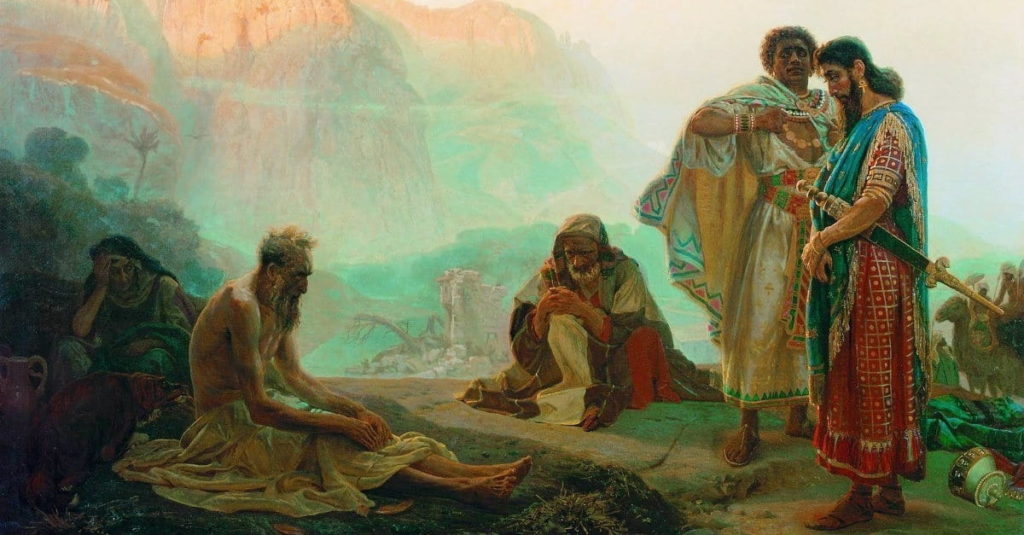
- Well, yesterday was quite the story, wasn’t it? Chapters 3-37 of Job now portray in great detail the conversation that Job has with the friends that we met at the end of chapter 2. In chapter 3 we read Job’s opening comments, and then in chapter 4 we hear the first response of one of his friends, Eliphaz. There is a lot of conversation and metaphor in this passage. If you find it harder to read passages like this (as opposed to stories like in Job 1) then take your time and try and get a general overview of what is happening rather than worrying about every specific verse.
- In chapter 3, Job’s speaks from the heart as he lays bare his anguish at his situation. He complains bitterly to his friends, wishing that he had never been born (3:3) because – he claims – it would have been preferable to the anguish he’s currently facing. Read through the rest of his monologue, and pick out some of the other things he says.
- What do you think when you read such words in the bible? These aren’t carefully chosen words of poetry or pious instruction. These are words of despair. In verses 11-19 Job is longing for rest, for example. The bible doesn’t hide from this, nor ever warn us that we won’t have similar struggles. Jesus knows our struggles and, like Job, it’s OK to bring them to him. Do you?
- How does Job convey his bitterness whilst still “not sinning with his lips” (chapter 2:10)? Notice, for example, that he never curses God (nor does he throughout the book). Note too that, despite wishing that he hadn’t been born, Job never contemplates suicide either.
- In chapter 4, try and work out what Eliphaz’s basic response was. What was he trying to tell Job? Focus in on verses 7 and 8 if you’re struggling, and see if that helps you.
- You may have noticed that Eliphaz isn’t being totally helpful! His general response to his friend Job is that he must have done something wrong to incur the afflictions and sufferings that he has received. Do you agree? Why or why not?
- Imagine your friend asks you why bad things happen to good people. Have a go at writing down the answer you might give, word for word, in your journal or some place separately. It will force you to think through your own thoughts and concerns, and may well help if you ever have to discuss the question.
- How does God depict Job in today’s link passage in Ezekiel??
Let’s think a bit more about the question “why do bad things happen to good people?”. I think the starting point should be to ask whether that is a helpful question to ask!
Job did not understand why God had allowed the things He did, but he knew God was good and therefore continued to trust in Him. Ultimately, that should be our reaction as well.
First question to ask ourselves, of course, is what a “good person” is. Are there any? Well, it depends what criteria you measure people against. I would hope many people would describe me as a “good person” – by which they would mean that I keep within the law, I’m generally pleasant to people I meet, I try to put others first, I help out at church, and so on. Yup, compared to some people, I’d like to think I’m “good”.
But if the criteria is God’s criteria, then suddenly I fall flat. Look at Romans 1:28-31: “Furthermore, just as they did not think it worthwhile to retain the knowledge of God, so God gave them over to a depraved mind, so that they do what ought not to be done. They have become filled with every kind of wickedness, evil, greed and depravity. They are full of envy, murder, strife, deceit and malice. They are gossips, slanderers, God-haters, insolent, arrogant and boastful; they invent ways of doing evil; they disobey their parents; they have no understanding, no fidelity, no love, no mercy.”
I wouldn’t like to describe myself as any of these words, but if truth be told, I’m guilty of most, if not all, of them. According to that list, I’m not good at all. In Romans 3, it continues “…there is no one righteous, not even one; there is no one who understands, no one who seeks God. All have turned away…”
“Got Questions”, a Christian Q&A site, adds the following. “A better question would be “Why does God allow good things to happen to bad people?” Romans 5:8 declares, “But God demonstrates his own love for us in this: While we were still sinners, Christ died for us.” Despite the evil, wicked, sinful nature of the people of this world, God still loves us. He loved us enough to die to take the penalty for our sins. If we receive Jesus Christ as Saviour, we will be forgiven and promised an eternal home in heaven. What we deserve is hell (separation from God). What we are given is eternal life in heaven if we come to Christ in faith.”
You might find the words of Proverbs 3:5-6 helpful too: “Trust in the LORD with all your heart and lean not on your own understanding; in all your ways acknowledge Him, and He will make your paths straight”.
One final thought. It’s not biblical to say that because someone suffers more than someone else, it’s because they are worse, or have sinned more. Don’t fall into the trap of thinking that every bad thing that happens to you is because God is punishing you for a specific sin in your life. Bad things happen to people who seem to be undeserving of such things. Good things happen to people who spend their lives in wickedness. Yes, it’s unfair. It’s simply the result of a fallen and imperfect world polluted by sin. As Christians, we can look forward to a time when the “old order of things has passed away”, where “there will be no more death or mourning or crying or pain”. And give thanks that Jesus, in His absolute mercy, has shown us the way there.
Leave a Reply
You must be logged in to post a comment.